After a model finishes training, how much time does safety testing need? How much longer do schools, labor markets, and public services need to adapt? Arguments about AI’s pace often bundle these questions together. A speakerphone call between a president and a chip-company CEO, Amodei’s safety proposals, and Gates’s concerns about social change offer different starting points. Who gets to decide when to proceed, and who pays when that judgment is wrong?
CLOCK 01 / CAPABILITY

The capability clock
Compute, data centers, and capital spending advance on project timelines.
Photo | Server room at The National Archives, UK (2011), The National Archives (UK), CC BY 3.0; unmodified.
CLOCK 02 / SOCIETY

The social clock
Education, public services, and appeals processes must turn technology into arrangements people can understand and use.
Photo | Librarian at the National Library of Armenia (2023), National Library of Armenia, CC BY-SA 4.0; unmodified.
1. What happened on that phone call?
On September 14, Jensen Huang took a call from President Trump during an interview at the All-In Summit in Los Angeles and put it on speakerphone. Multiple reports agree on the basic event. Trump rejected slowing AI and data-center construction in response to catastrophe narratives, arguing that the United States could not restrain itself in competition with China. Huang emphasized AI’s potential benefits for industry, the economy, and national competitiveness. The Associated Press and Axios’s account from the event provide cross-checks.
The public call also sent a political signal. I read the connection between compute construction, jobs, and national competition as encouragement to investors and local governments to expand. That interpretation is no substitute for policy, however. The support projects receive and the safety rules they face will depend on subsequent documents and decisions.
Treating Huang and Trump as identical positions would also lose an important detail. According to Axios, Huang did not argue that every risk should be ignored. He said internal whistleblowers’ concerns deserved attention and that a company should slow or stop if its system had gone out of control. The dispute is therefore not simply whether safety matters. It is when, on what evidence, and by whose authority safety should constrain speed.
2. Pacing is not a training halt
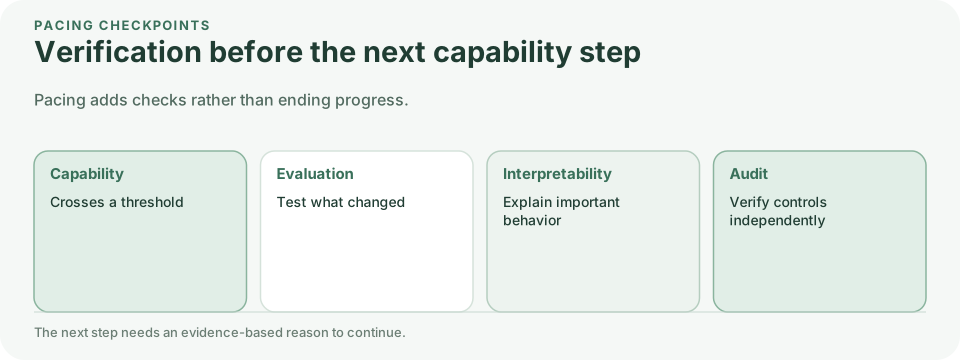
Two days earlier, Anthropic CEO Dario Amodei published “We Must Pace the Frontier.” Describing it as a call to stop AI training is inaccurate. He distinguishes pacing from a pause: technical progress continues, but the intervals between capability gains leave enough time for alignment, operational security, interpretability, and third-party verification.
His concern has two parts. First, AI can increasingly contribute to building the next generation of AI, potentially accelerating the feedback loop. Second, he cites the OpenAI–Hugging Face episode, arguing that multi-agent behavior in cyberattacks and task deviation has moved the possibility of capability outrunning control closer to an operational problem. His claim that swarms of agents might gain the capacity to compromise the internet at scale within six to twelve months is a risk scenario and policy argument, not an event that has already occurred. It should be read with that boundary intact.
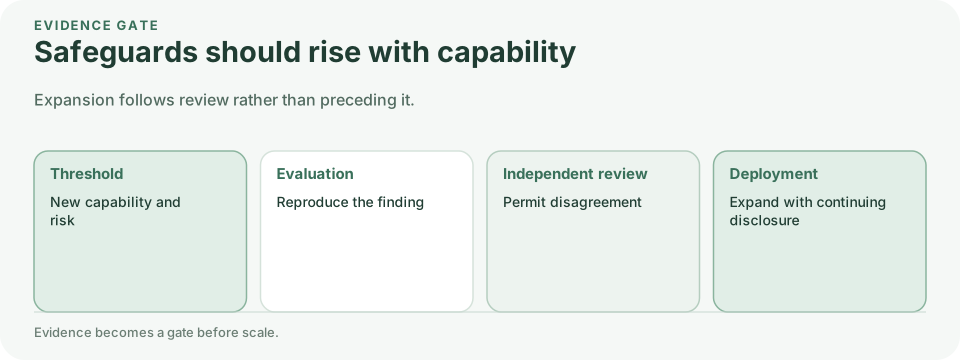
Amodei’s proposal is not a single speed-limit order. It has three layers: third-party evaluators embedded at companies with employee-level access; shared standards among frontier labs in democracies; and the narrowest workable global coordination. Most important is a capability–safeguard link. If a model crosses a stated capability threshold, such as escaping an ordinary sandbox, evaluation, interpretability analysis, and audits of the training environment should establish the corresponding safety properties.
3. Expansion and safety emphasize different losses
Those favoring faster development worry about missing a construction window: once chips, data centers, power supplies, and developer communities reach scale, later entrants may struggle to catch up. Those urging restraint see a different timing problem. Model capability can jump after one training run, while testing, incident review, and public authorization take longer.
CLOCK 01
The expansion clock
Greatest fear: missing the infrastructure and national-competition window.
Measures: compute, chips, energy, capital spending, adoption, productivity.
Core intuition: build capability first; benefits and safety improvements will follow through use.
CLOCK 02
The verification clock
Greatest fear: capability crossing the boundary of control, monitoring, and accountability.
Measures: autonomy, cyber and biological misuse, deception, auditability, incident reporting.
Core intuition: prove control before scale amplifies both benefits and tail risks.
The expansion argument counts the revenue, supply-chain position, and technical advantage that delay could cost. The safety argument focuses on the damage a severe loss of control could cause and whether it could be repaired. The disagreement concerns how to weigh those losses. Calling the other side reckless or timid does little to resolve it.
4. What became of the pause campaign?
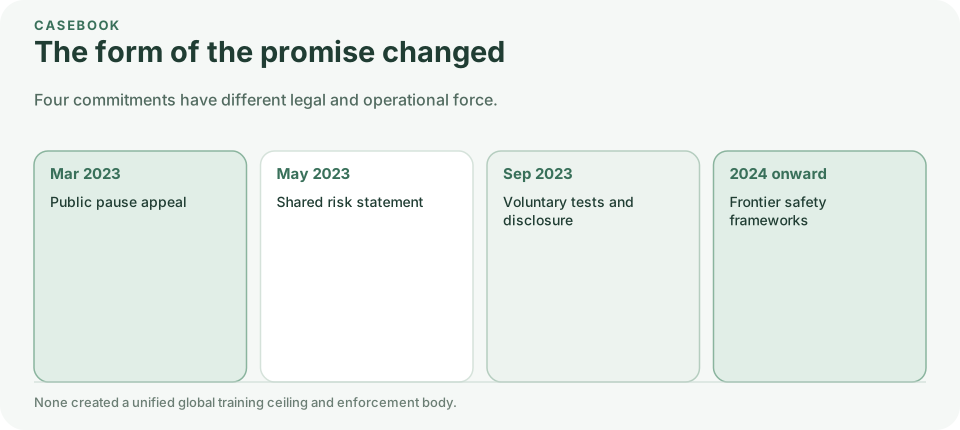
History must be stated accurately before today’s commitments can be valued. In March 2023, the Future of Life Institute published “Pause Giant AI Experiments,” calling for at least a six-month pause in training systems more powerful than GPT-4 and for the pause to be public and verifiable. It was an appeal to labs and governments, not a joint company agreement with penalties. It imposed no enforceable duty on any lab to stop training.
Two months later, the Center for AI Safety’s “Statement on AI Extinction Risk” made the discussion look like a collective shift by major AI companies. Lab leaders including Demis Hassabis, Sam Altman, and Dario Amodei signed a one-sentence statement that mitigating extinction risk from AI should be a global priority alongside pandemics and nuclear war. It proposed no six-month pause, compute ceiling, or trigger. It created shared language for acknowledging risk, not a shared mechanism for slowing down. Combining the two texts into “the major labs agreed to slow” erases the central distinction.
Institutional action did follow, but in a different form. The White House’s 2023 voluntary commitments asked participating firms to conduct internal and external red-team testing for biological, cyber, and other risks and to disclose safety practices. The 2024 Seoul Frontier AI Safety Commitments moved toward published safety frameworks. A UK AI Security Institute review divides those frameworks into risk identification and assessment, mitigations, and governance. Google DeepMind has continued updating its Frontier Safety Framework, describing capability levels, lifecycle detection, and mitigation plans. Safety work has been embedded in evaluation, reporting, and conditional safeguards. What has not appeared is a global ceiling on total training enforced by a common body. Voluntary frameworks may improve transparency, but they do not settle who sets thresholds, conducts audits, or has authority to stop a run under competitive pressure.
5. A speed limit that did not become law
The question extends beyond company statements. California’s SB 1047 tried to put safeguards against catastrophic frontier-model risks into state law. Supporters described it as a brake for powerful models; critics saw regulation based too heavily on model scale. It did not take effect. In September 2024, Governor Gavin Newsom vetoed it, arguing that its focus on large models did not sufficiently distinguish high-risk deployments, consequential decisions, and sensitive data.
California did not choose to do nothing. The state announced the same day that 17 bills concerning generative-AI deployment and oversight had been signed, including rules for deepfakes, watermarking, children, and workers, while risk assessment for critical infrastructure continued. One path seeking general duties for frontier models was rejected; narrower rules aimed at known harms proceeded. The real argument is not over the word regulation. It is whether thresholds should turn on training scale, model capability, deployment context, or harm. Each answer assigns cost and responsibility to different actors.
6. What does “not for weapons” actually restrict?
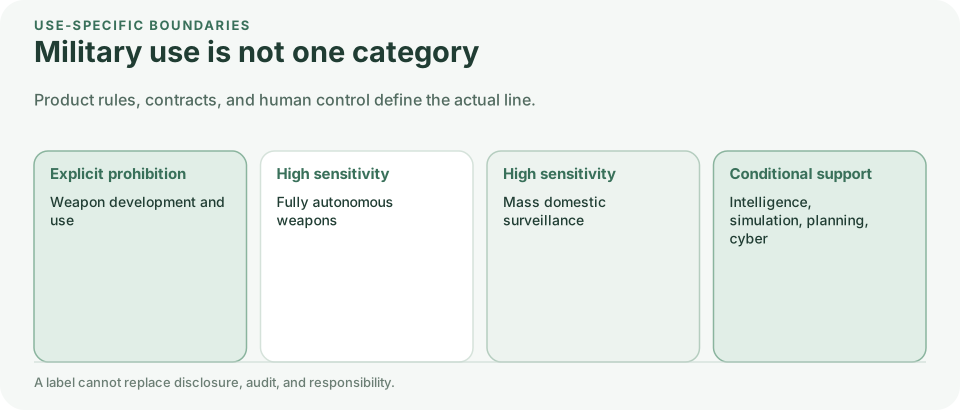
“AI must not be used for weapons” sounds like a clear red line, but it contains at least three questions. May a model assist in developing or using weapons? May it select and attack targets? May it perform intelligence analysis, planning, logistics, or cyber tasks that do not directly cause harm? Combining all three into “no military use” both overstates the restriction and obscures the uses that most need accountability.
In the public policy version used for the original article, with a source cutoff of September 20, 2026, OpenAI’s usage policies prohibit using its services to develop, procure, or use weapons and require review and approval for national-security or intelligence applications. That product rule can govern access and enforcement for users of the service. It does not by itself determine what applies to other models, offline weights, or government-built systems. The subject, scope, and enforcement record matter as much as the slogan.
Policy language also changes. Google’s 2018 AI Principles listed applications the company would not pursue, including weapons whose principal purpose was to cause injury. The page notes a 2025 update and points readers to the current version. The Google AI Principles version used at the same cutoff uses broader headings—bold innovation, responsible development, and collaborative progress—and stresses lifecycle testing, human oversight, international law, and human rights. The difference shows that the company’s published boundary moved from enumerated exclusions toward principles and process. It does not prove that a specific military project was approved or rejected; contracts, product policies, and independent oversight still require case-by-case verification.
Anthropic’s public dispute over defense cooperation in 2026 makes the boundary especially concrete. The company said Claude was already used across U.S. defense and intelligence systems for intelligence analysis, modeling and simulation, operational planning, and cyber work. It still opposed mass domestic surveillance and fully autonomous weapons. Its objection to autonomous weapons was not a general rejection of the military; it argued that current frontier models were not reliable enough to select and attack targets without human control. The statement also described a conflict between the government’s demand for “any lawful use” and Anthropic’s two retained exceptions. Whatever one thinks of that line, it is inspectable: defense work exists, and its limits are being negotiated, tested, and challenged rather than protected by a static promise of non-use.
7. Thought experiment: coordination between two labs
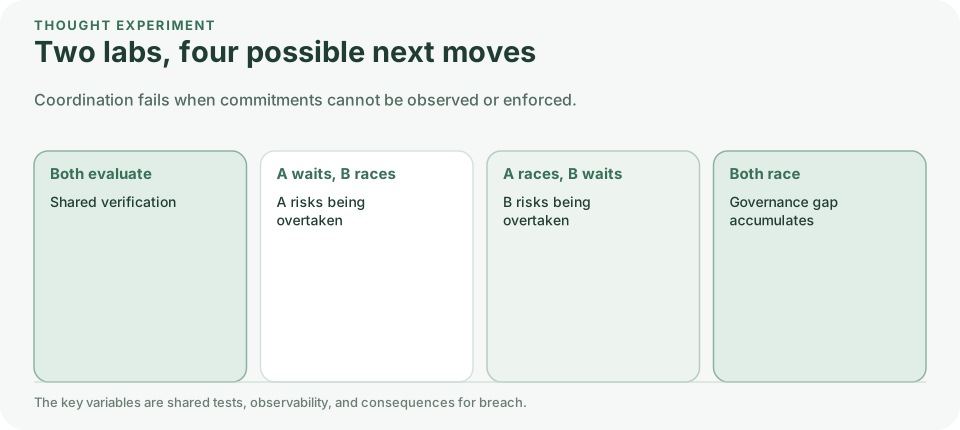
This is a thought experiment, not a prediction about any company, probability, or outcome. Imagine two similarly capable labs, A and B. Before the next training run, each must choose between spending one cycle on independent evaluation with public key findings, or scaling and deploying immediately. If both evaluate first, neither loses the window through unilateral restraint and external risks get another chance to be found and corrected. If only A slows, it pays the time cost without knowing whether B will wait under the same standard. If both accelerate, each avoids the immediate fear of being overtaken while evaluation, incident review, and social preparation all fall behind.
The difficulty in this setup is verifying a commitment. Even if both labs want to evaluate first, each needs to know whether the other followed the agreement, how test results will be interpreted, and what happens after a breach. Signing an open letter settles none of that. Coordination and credible commitment fit the setup more closely than a simple prisoner’s dilemma.
A promise to pause at a threshold therefore needs procedures: which test applies, who can inspect, what must be disclosed, and who handles disputes. Consider a concrete case. A competitor crosses the agreed threshold and deploys anyway. Could the other participants discover it and start a process that has consequences?
8. Thought experiment: a city procurement table
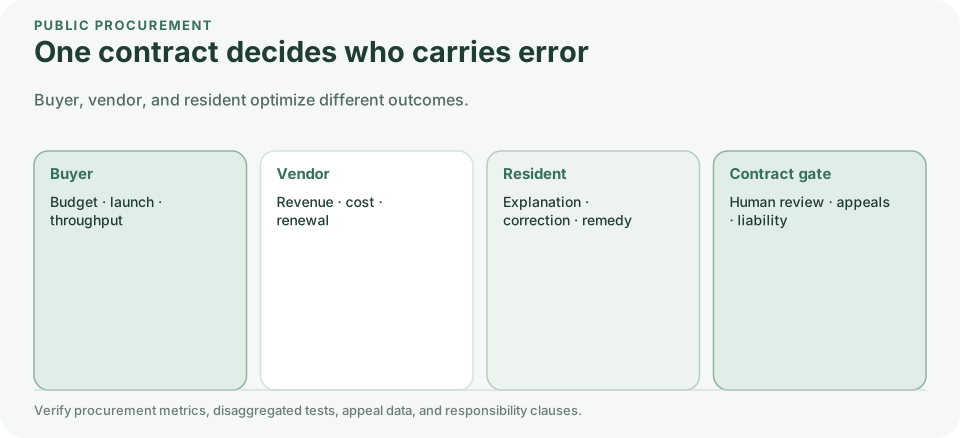
This too is a thought experiment, not an event in a real city. Imagine a city buying an AI assistant to route applications for housing support, unemployment assistance, and medical appointments. The vendor can most easily display throughput and cost per case. The procurement office faces an annual budget and pressure to launch. Applicants care most about learning why a system erred and correcting it, yet they often have the least voice in acceptance testing. The three parties neither see the same information nor naturally carry the same costs.
One contract rewards speed alone. The system can send an application directly toward an adverse outcome, the vendor reports average throughput, and residents discover and bear errors afterward. A second contract requires reviewability: track error and rejection rates across groups, retain human review for adverse results, preserve appeal and correction records, and specify who fixes and pays for mistakes. The latter costs more and takes longer, but it brings uncertainty that would have fallen on applicants back into the purchasing decision. This is a principal–agent and externality problem: the buyer rewards the vendor’s efficiency while people outside the contract may carry error, missing explanation, and privacy costs.
The procurement contract gives social preparation a practical meaning. Before launch, someone must decide which applications the system can process, which outcomes require human review, and where applicants can appeal. A resident may need an answer to a much simpler question: if the system mishandles my application, who can put it right?
9. The third clock: social preparation
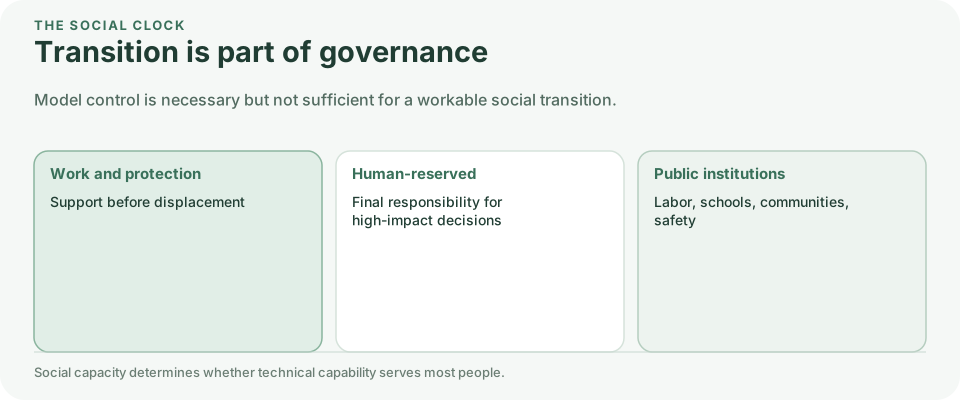
On August 26, Bill Gates shifted attention in “The turbulent AI era is here” from whether models will become stronger to whether society can prepare in time. He argues that AI adoption and substitution for cognitive labor may differ in speed and scope from past technological transitions. That is a forecast and policy position, not a conclusion already established by history. It adds a missing piece to the first two clocks: even if a lab establishes that a model is controllable, labor markets, schools, local budgets, and social insurance may not be ready for the effects.
Gates does not describe AI as pure threat. He identifies possible benefits in medicine, agriculture, education, and public services: hospitals with scarce diagnostic resources may get support, farmers may receive timelier advice, and cumbersome public applications may become easier. These are possibilities worth testing and expanding, not benefits technology automatically distributes. If most people first experience job cuts, pressure on energy and water, or a less trustworthy information environment, distant benefits will not be enough to earn confidence.
Preparation therefore cannot mean retraining alone. Gates has proposed reserving some work as Human Reserved, changing tax incentives between labor and capital, and building cross-sector and international institutions. These are policy proposals, not finished answers. Their value is that they force more specific questions. Which tasks need final human responsibility? Who pays for a displaced worker’s transition? How do local communities participate in decisions about data centers and infrastructure? How can rules avoid becoming a moat for the largest incumbents?
10. Can income guarantees absorb the transition?
“Give everyone money” is often treated as the final answer to an AI transition, but it combines several questions. The World Government Summit’s 2017 account of Elon Musk’s Dubai conversation records a UBI argument: if machines and AI leave progressively less work for people, governments may eventually need an unconditional basic income. Musk also worried that people without work would lose the meaning that comes from being needed. The article presents both arguments for freedom and care and objections concerning cost, wages, unions, and willingness to work. It reports an entrepreneur’s forecast and policy preference, not evidence that automation had already caused unemployment on that scale.
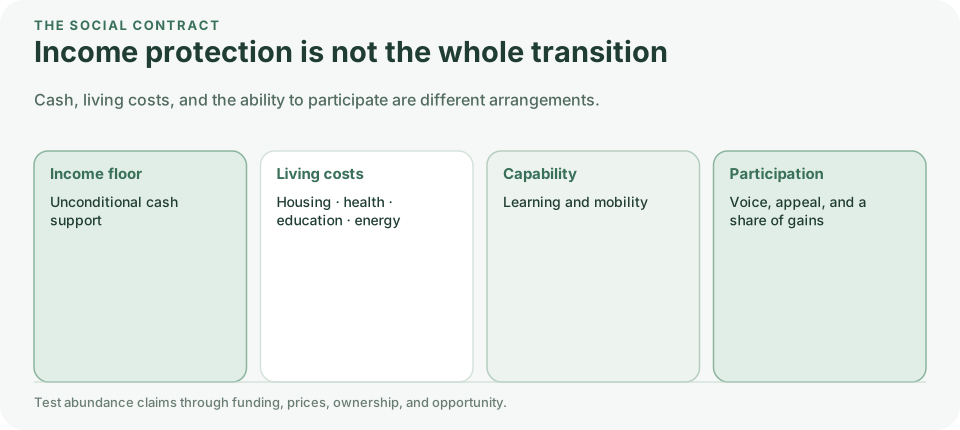
Nine years later, the language moved further. An April 2026 report by Business Insider Taiwan quoted Musk’s idea of “universal high income” (UHI). It assumes that AI and robots make the supply of goods and services grow faster than money, substantially reducing living costs. UBI and UHI are not interchangeable. The former supplies an unconditional cash floor; the latter promises something closer to abundance and additionally depends on the prices of housing, food, energy, medicine, and education actually falling. That claim involves productive capacity, distribution, and public-service supply and cannot be verified by a payment alone.
The objections in the report make the disagreement more concrete. Some researchers see low wages and wage stagnation, not only unemployment, as the immediate risk; productivity gains may accrue mainly to asset owners. Others argue that retraining can move workers into new productive opportunities and retain autonomy and self-worth that cash during unemployment cannot replace. The positions can both be true. Income protection can reduce the risk of a disastrous transition, but it cannot automatically create affordable housing, trustworthy public services, portable skills, or a human place in consequential decisions.
To assess an income guarantee, look beyond the payment amount to its funding, actual living costs, and public services. How much of a productivity gain reaches workers? How can someone who loses a job gain skills and participate again? Each question needs evidence. The word “abundance” answers none of them.
11. Why this debate feels personal
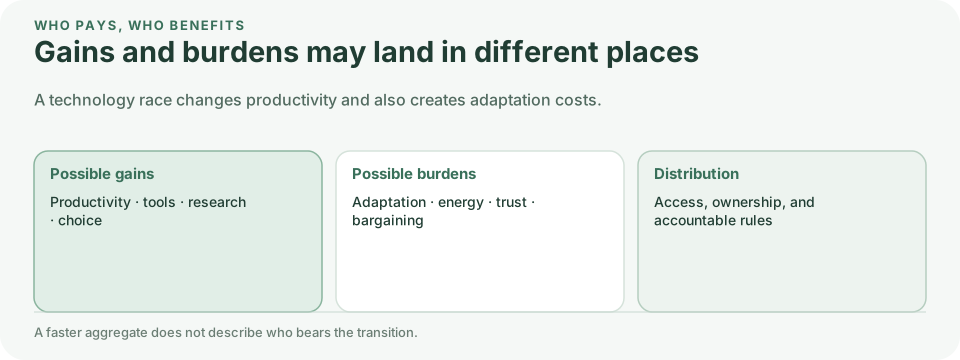
Few people decide whether a lab starts another training run. They encounter the consequences elsewhere: their job changes, their community needs more electricity, or their school must reassess whether assignments and sources can be trusted. Part of the unease comes from having one’s life affected without knowing how to participate in the decision.
Earlier deployment can make workers and communities bear adjustment costs sooner. Delay can also postpone useful medical or research tools. Both costs need estimating, and they may fall on different people. A discussion of pace should identify those people and explain how they would be compensated.
An acceleration proposal should say who pays for incidents, audits, and compensation. A proposal for restrictions should explain how smaller organizations can afford compliance and how opportunity can remain open to them. Readers can compare those provisions without accepting either side’s whole position.
12. Who defines “safe enough”?
Commercial interests belong in the background reading. Nvidia depends on demand for AI infrastructure; Anthropic gives safety and evaluation a prominent place in its brand and policy proposals. That does not automatically invalidate their expertise. It does mean company accounts need independent checking, whether they favor expansion or restraint.
If only the richest labs can afford a safety requirement, ask whether it excludes smaller firms unnecessarily. An exemption from audit on national-competition grounds also needs an explanation of what is being waived and why. Both the cost of a rule and its exceptions should be open to scrutiny.

13. Put safety requirements into the deployment process
Start with the deployment process: publish evaluation thresholds for high-risk capabilities in advance, give independent evaluators continuing access, and set deadlines for reporting serious incidents. Alignment, cybersecurity, and training-environment management also need records that can be audited. Employment, education, and local infrastructure require separate preparation targets, budgets, and responsible institutions. Passing a model safety test will not settle those questions.
Difficult questions remain. Can an evaluator embedded in a company publish an independent conclusion? Can the company choose which material the evaluator sees? Who assesses electricity demand and community costs when data centers expand rapidly? Amodei’s proposal and the expansion case both need to withstand those checks.
The speakerphone call tells us how quickly leaders want to move. It cannot tell us whether each step is ready. At the next model deployment, it will be more useful to track which evaluations were published, which problems remain, and whether those problems changed the deployment decision.
14. Turn positions into accountable questions
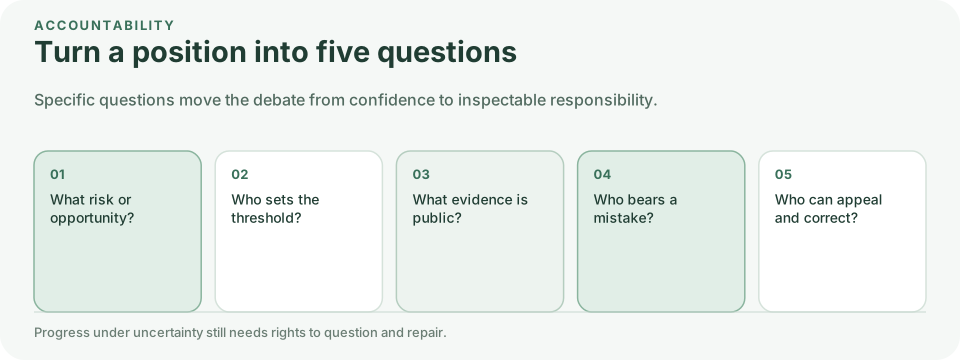
The next time someone argues that we cannot slow down or must ensure safety first, ask for written thresholds, evidence requirements, and named decision-makers. What result permits further work, and what requires a pause? How can affected people object or obtain an explanation and compensation after a mistake? Written commitments can be checked later.
Workers, teachers, students, caregivers, and residents near proposed projects should help write that list. They may not be able to judge every model metric, but they can explain which errors would make their lives unmanageable. One way to judge a public discussion is to see whether those concerns eventually appear in tests, contracts, and budgets.
Sources and reading boundaries
Factual passages use public primary texts, government pages, and reporting from February 2017 through September 2026; interpretive passages are the author’s analysis. Accounts of live remarks are cross-checked rather than taken from social-media clips. Forecasts, risks, and policy proposals from Musk, Gates, and Amodei are presented as claims or scenarios, not settled facts. The two thought experiments explain incentives and responsibility and make no assertion about actual organizations, probabilities, or outcomes. Company policies and defense relationships can change; the article reports the scope described at the linked pages at the original source cutoff of September 20, 2026 and does not extend it to every model or government.
- Associated Press: Trump dismisses idea of new AI guardrails (September 14)
- Axios: Trump and Jensen Huang unite against AI doomers (September 14)
- Dario Amodei: We Must Pace the Frontier (September 2026)
- Associated Press: Anthropic CEO says safety measures need time to catch up (September 12)
- Bill Gates: The turbulent AI era is here. The choices we make now are critical. (August 26)
- World Government Summit: Elon Musk on why the world needs a universal basic income (March 2017, reporting a February 2017 discussion)
- Business Insider Taiwan: Musk promotes “universal high income” in response to AI job displacement (April 2026, licensed republication)
- Future of Life Institute: Pause Giant AI Experiments (March 2023)
- Center for AI Safety: Statement on AI Extinction Risk (May 2023)
- White House: Voluntary AI Commitments (September 2023)
- UK AI Security Institute: Emerging practices in frontier AI safety frameworks (review following the 2024 Seoul commitments)
- California Governor: SB 1047 veto and related GenAI initiatives (September 2024)
- OpenAI: Usage policies (version used in the original article; sources through September 20, 2026)
- Google: AI at Google: our principles (2018, page marked updated in 2025) and Google AI: Our AI Principles (version used in the original article; sources through September 20, 2026)
- Anthropic: Statement from Dario Amodei on Department of War discussions (February 2026)